SocialMaze: A Benchmark for Evaluating and Enhancing Social Reasoning in Large Language Models in Complex Social Environments
Benchmarking LLM social reasoning across six tasks with deep inference, dynamic multi-turn interaction, deception, and information uncertainty.
1 MBZUAI · 2 University of Southern California · 3 University of Notre Dame · 4 University of Michigan, Ann Arbor · 5 University of Chicago · 6 Microsoft
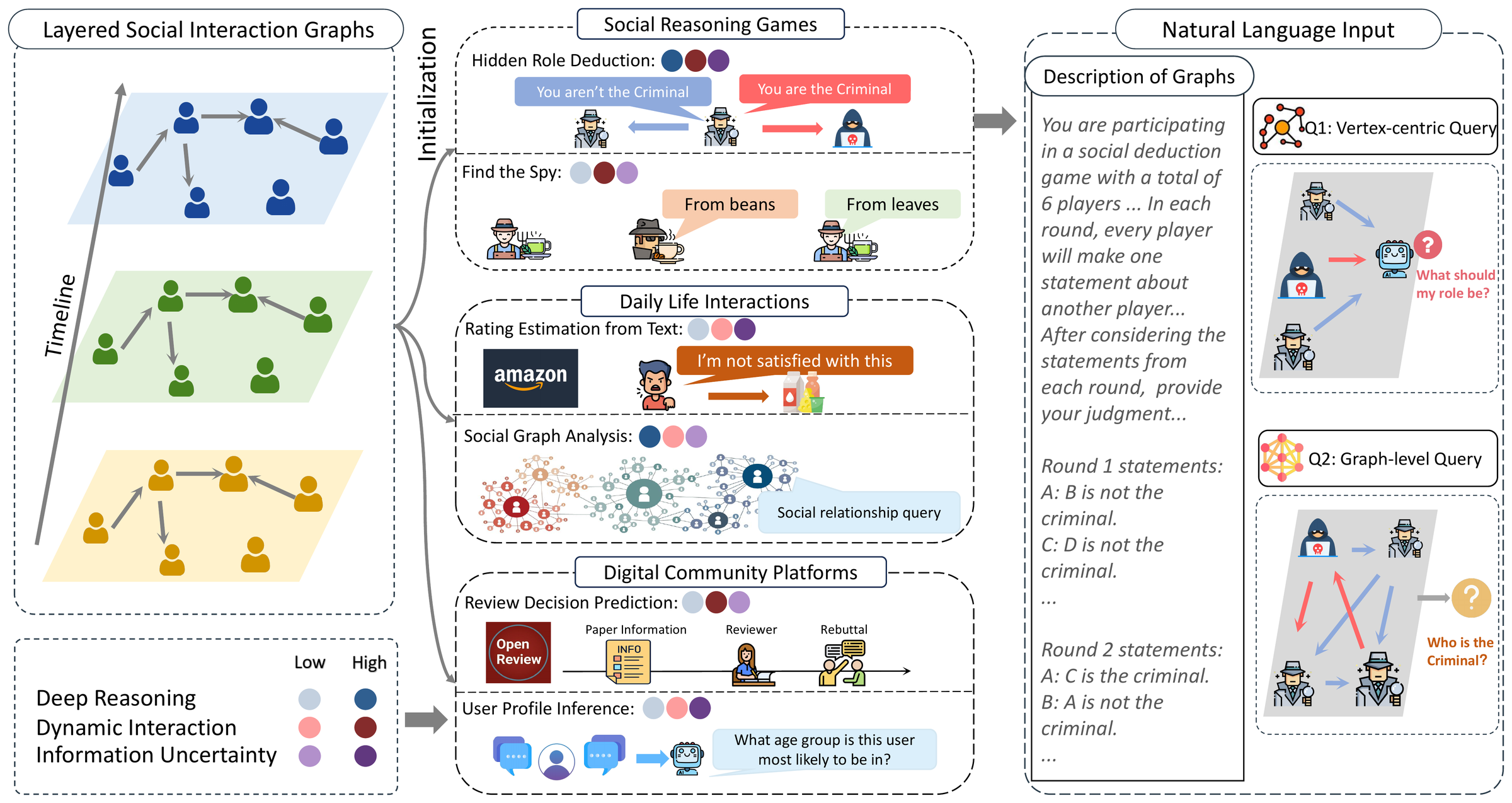
Overview: An LLM Social Reasoning Benchmark
SocialMaze is a six-task benchmark for evaluating social reasoning in large language models across complex, evolving environments. It tests whether models can integrate multi-turn interaction histories, infer hidden roles and mental states, and reason under deception and unreliable information.
SocialMaze organizes task construction along three descriptive design axes — deep reasoning, dynamic interaction, and information uncertainty. These axes describe intended sources of task difficulty rather than latent, factor-analytic dimensions of model capability. The benchmark contains 70,000 instances across six tasks and three settings, created through a mix of algorithmic generation, authentic human data, and LLM-assisted discourse, with automated checks and targeted human validation.
The accepted paper makes three contributions:
- It defines deep reasoning, dynamic interaction, and information uncertainty as three descriptive axes for constructing controlled social-reasoning evaluations.
- It instantiates those axes in six tasks across social deduction games, daily-life interactions, and digital community platforms.
- It evaluates twelve proprietary and open-weight LLMs, showing where reasoning workflows help and where targeted fine-tuning transfers beyond the training task.
How SocialMaze Fits into Social Reasoning Evaluation
SocialMaze bridges traditional Theory-of-Mind evaluation and open-ended social-agent benchmarks by measuring verifiable social reasoning over evolving interaction histories and unreliable information. It includes mental-state and hidden-role inference, but treats these as part of a broader challenge: combining deep inference with dynamic, multi-turn interaction, deception, and information uncertainty.
Unlike evaluations centered on isolated belief questions, SocialMaze spans six tasks in social-deduction games, daily-life interactions, and digital community platforms. Unlike open-ended social-agent environments that primarily measure goal completion or interaction quality, SocialMaze emphasizes whether a model's social inferences are correct and how those inferences change as new evidence arrives.
Abstract
Large language models (LLMs) are increasingly deployed in socially grounded applications, where success requires interpreting context, inferring others' mental states, and reasoning about unreliable information. Yet existing benchmarks rarely evaluate these demands jointly in complex, evolving settings. We introduce SocialMaze, a benchmark that organizes six tasks across social deduction games, daily-life interactions, and digital community platforms along three descriptive design axes: deep reasoning, dynamic interaction, and information uncertainty. These axes characterize intended sources of task difficulty rather than latent, factor-analytic dimensions of model capability. Automated checks and human validation support data quality. Evaluations of twelve proprietary and open-weight LLMs show substantial variation in the use of evolving interaction histories; stronger chain-of-thought reasoners perform better on tasks requiring deeper inference, while uncertainty consistently degrades performance. Reasoning workflows help weaker short-chain-of-thought backbones but saturate on stronger reasoners. Finally, targeted fine-tuning on curated reasoning traces substantially improves structured social-reasoning tasks, whereas transfer to language-aggregation tasks remains statistically inconclusive.
Key Findings & Why They Matter
1.First-round performance remains limited
In the six-player Hidden Role Deduction evaluation, first-round accuracy at identifying the Criminal ranges from 22.4% (DeepSeek-V3) to 45.8% (o3-mini) across twelve models. Later rounds reveal substantial variation in how effectively models use the evolving interaction history.
2.Long chain-of-thought helps where reasoning is deep—at a cost
Models with long chain-of-thought reasoning achieve substantially higher accuracy on tasks that require deep reasoning (Social Graph Analysis and Hidden Role Deduction), producing nearly 8× more output tokens on those tasks. On shallower tasks the advantage shrinks. Different model families have different strengths: reasoning-oriented models lead on structured deduction, while strong generalists such as DeepSeek-V3 and GPT-4o lead Review Decision Prediction.
3.Models differ sharply in using dynamic interaction
As more rounds of player statements accumulate in Hidden Role Deduction, some models integrate the new evidence and others stall. Over three rounds, Gemini-2.5-Pro climbs from 43.3% to 87.6% and DeepSeek-R1 from 44.3% to 80.4%, whereas GPT-4o plateaus, moving only 39.5% → 53.3% → 53.5%. This contrast reveals sharp differences in how evaluators use temporally evolving information.
4.Reasoning degrades under uncertainty—and rebuttals can mislead
Injecting unreliable actors—an intentionally deceptive Criminal, or self-deceived Rumormonger and Lunatic roles—sharply lowers Criminal- and self-role accuracy. The effect also appears in peer review: in Review Decision Prediction, accuracy jumps once reviews appear, but 10 of 12 evaluators decline after reading the rebuttal—e.g., Llama-3.3-70B moves 26.2% → 87.4% → 72.2%. GPT-4o and DeepSeek-V3 move upward, but those increases do not survive family-wise significance correction.
5.Workflows help weaker backbones; fine-tuning improves structured reasoning
On a weaker short-chain-of-thought backbone, six reasoning workflows improve Hidden Role Deduction Both-Correct accuracy by roughly +4.0 to +8.4 points, with DyFlow producing the clearest gain. On DeepSeek-R1, however, all tested workflows stay within ±2 points of the base model, indicating saturation. Supervised fine-tuning on curated reasoning traces raises Both-Correct accuracy from 15.4% to 26.0% for Llama-3.1-8B and from 20.4% to 31.0% for Phi-4. Transfer is robust on Social Graph Analysis, borderline on Find the Spy, and statistically inconclusive on the three language-aggregation tasks.
Inside the Benchmark: Six Tasks, Three Settings
SocialMaze organizes six tasks into three real-world-inspired settings, and positions each task along three descriptive design axes—Deep Reasoning, Dynamic Interaction, and Information Uncertainty. Per-task instance counts below are from the paper's task overview.
Total across six tasks: 70,000 instances.
How SocialMaze Evaluates Dynamic Social Reasoning
SocialMaze is built on a graph-based formalization of social scenarios. Participants and their evolving interactions are modeled as layered social interaction graphs over a timeline, and tasks pose vertex-centric queries (about one actor), edge-centric queries (about a relationship), or graph-level queries (about the whole scenario), rendered as natural-language input. This lets the benchmark vary intended task difficulty along the three design axes.
The flagship task, Hidden Role Deduction, asks a model to read several rounds of player statements and identify both the true Criminal and its own role; the headline evaluation uses six players and three rounds. Data combines algorithmic generation, authentic human sources (Amazon, Google Play, and Taobao reviews; OpenReview submissions and decisions), and LLM-assisted discourse. Algorithmic tasks use solvability and uniqueness checks, while targeted human validation supports the quality of sampled instances—for example, annotators could uniquely identify the Spy in 91% of sampled Find-the-Spy instances and recover the true rating in 83% of sampled LLM-generated Rating-Estimation instances.
Dataset: SocialMaze on Hugging Face
The benchmark's most representative task, Hidden Role Deduction, is released on the Hugging Face Hub as xzx34/SocialMaze in a convenient question-answering format.
200,000 corrected, uniquely solvable instances · 100,000 easy + 100,000 hard · exact 1:1:1:1 Player 1 role balance in each split · CC BY 4.0 license · stable IDs, validation reports and SHA-256 checksums.
from datasets import load_dataset

# Hidden Role Deduction, QA format (splits: "easy", "hard")
ds = load_dataset("xzx34/SocialMaze", split="hard")
This 200,000-instance dataset is a corrected expanded HRD-only release, not a complete mirror of the paper's six-task, 70,000-instance evaluation collection. The GitHub repository provides the maintained HRD implementation and corrected data tooling; the other five tasks have archived scripts and demonstration samples. MBZUAI/SocialMaze is an outdated 2025 mirror retained only for legacy reference and should not be used for new experiments.
Frequently Asked Questions
What is SocialMaze?
SocialMaze is a Findings of EMNLP 2026 benchmark for evaluating and enhancing social reasoning in large language models, previously presented as a Spotlight Talk at SocialSim @ COLM 2025. It organizes six tasks across three settings along three descriptive design axes — deep reasoning, dynamic interaction, and information uncertainty. These axes describe intended sources of task difficulty rather than latent dimensions of model capability. The benchmark contains 70,000 instances, supported by automated checks and targeted human validation.
How does SocialMaze differ from Theory-of-Mind and social-agent benchmarks?
SocialMaze is broader than a narrow Theory-of-Mind benchmark: it includes mental-state and hidden-role inference while also testing whether models integrate evolving interaction histories, detect deception, and reason over uncertain social information. It also differs from open-ended social-agent benchmarks that primarily measure goal completion or interaction quality. SocialMaze emphasizes verifiable reasoning correctness across six tasks in social games, daily-life interactions, and digital community platforms.
What are the six tasks and three settings in SocialMaze?
The three settings and their tasks are: Social Reasoning Games — Hidden Role Deduction (20,000 instances) and Find the Spy (6,000); Daily-Life Interactions — Rating Estimation from Text (6,000) and Social Graph Analysis (20,000); and Digital Community Platforms — Review Decision Prediction (12,000) and User Profile Inference (6,000). Each task is positioned to stress different combinations of deep reasoning, dynamic interaction, and information uncertainty.
What is the Hidden Role Deduction task?
Hidden Role Deduction is SocialMaze's flagship task: a configurable social-deduction game in which a model reads rounds of player statements and must identify both the true Criminal and its own assigned role. The headline evaluation uses six players and three rounds, and the task is marked High on all three descriptive design axes. An expanded QA-format release is available on Hugging Face.
How well do current LLMs perform on SocialMaze?
Social reasoning is far from solved. In the six-player Hidden Role Deduction evaluation, first-round Criminal-identification accuracy ranges from 22.4% to 45.8% across twelve models. Strong chain-of-thought models such as DeepSeek-R1 and Gemini-2.5-Pro improve markedly as more rounds accumulate — Gemini-2.5-Pro reaches 87.6% by the third round — while GPT-4o plateaus near 53%. Accuracy degrades further under deception and information uncertainty.
How does SocialMaze enhance social reasoning?
The accepted paper evaluates reasoning workflows and targeted fine-tuning on curated reasoning traces. Workflows improve a weaker short-chain-of-thought backbone by roughly 4.0 to 8.4 percentage points on Hidden Role Deduction but saturate on DeepSeek-R1. Supervised fine-tuning produces a 10.6-point Both-Correct gain on both Llama-3.1-8B and Phi-4; transfer is robust for Social Graph Analysis and statistically inconclusive for language-aggregation tasks.
Where can I download the SocialMaze dataset?
The maintained Hidden Role Deduction release is available on the Hugging Face Hub as xzx34/SocialMaze: 200,000 corrected, uniquely solvable instances (100,000 easy and 100,000 hard) under CC BY 4.0. The GitHub repository provides maintained HRD code and data tooling plus archived scripts and demonstration samples for the other five tasks. MBZUAI/SocialMaze is an outdated 2025 mirror and is not recommended for new experiments.
When should I cite SocialMaze?
Cite SocialMaze when your work involves evaluating social reasoning or social intelligence in LLMs, reasoning beyond isolated Theory-of-Mind questions, social-deduction games, evolving epistemic or interaction histories, robustness under deception or information uncertainty, or reasoning workflows and fine-tuning for complex social tasks. See the When to Cite This Paper section below for a ready-to-use citation sentence.
When to Cite This Paper
SocialMaze is a useful reference when your work touches any of the following:
- evaluating social reasoning or social intelligence in large language models beyond isolated Theory-of-Mind questions;
- social-deduction games (e.g., hidden-role / Werewolf-style reasoning) with LLMs;
- multi-turn social interaction and evolving epistemic or interaction histories;
- robustness of reasoning under deception, noise, or information uncertainty;
- chain-of-thought reasoning for complex, socially grounded inference;
- LLM agents and workflows versus targeted fine-tuning for hard reasoning tasks;
- LLMs for community moderation, review-decision prediction, or user-profile inference.
A typical citation: Xu et al. (2026) introduce SocialMaze, a six-task benchmark for evaluating and enhancing social reasoning in complex social environments, and show that reasoning workflows help weaker backbones while targeted fine-tuning transfers most clearly to structured reasoning tasks.
Resources
- arXiv:2505.23713 — preprint abstract page.
- EMNLP 2026 — accepted to Findings; proceedings metadata is forthcoming.
- SocialSim @ COLM 2025 — previously presented as a Spotlight Talk.
- Dataset on Hugging Face — corrected expanded HRD v2.0.0 (200,000 instances, CC BY 4.0), loadable with the
datasetslibrary. - Code on GitHub — maintained HRD code and corrected data tooling, with archived scripts and demonstration samples for the other five tasks.
BibTeX
@inproceedings{xu2026socialmaze,
  title={{SocialMaze}: A Benchmark for Evaluating and Enhancing Social Reasoning in Large Language Models in Complex Social Environments},
  author={Xu, Zixiang and Wang, Yanbo and Huang, Yue and Zhuang, Haomin and Zhou, Yujun and Ye, Jiayi and Li, Sixian and Song, Zirui and Gao, Lang and Wang, Chenxi and Chen, Zhaorun and Pan, Wang and Zhao, Yue and Zhao, Jieyu and Zhang, Xiangliang and Chen, Xiuying},
  booktitle={Findings of the Association for Computational Linguistics: EMNLP 2026},
  month={October},
  year={2026},
  address={Budapest, Hungary},
  publisher={Association for Computational Linguistics},
  note={To appear},
  eprint={2505.23713},
  archivePrefix={arXiv},
  primaryClass={cs.CL},
  url={https://arxiv.org/abs/2505.23713}
}