Cross-Lingual Pitfalls: Automatic Probing Cross-Lingual Weakness of Multilingual Large Language Models
Discovering cross-lingual LLM failures through search-based multilingual evaluation: where a model answers correctly in English but fails on a semantically checked question in another language.
ACL 2025 (Long Paper)
1 MBZUAI · 2 University of Notre Dame · 3 University of Southern California
* Equal contribution · † Corresponding author:
xiuying.chen@mbzuai.ac.ae,
xzhang33@nd.edu
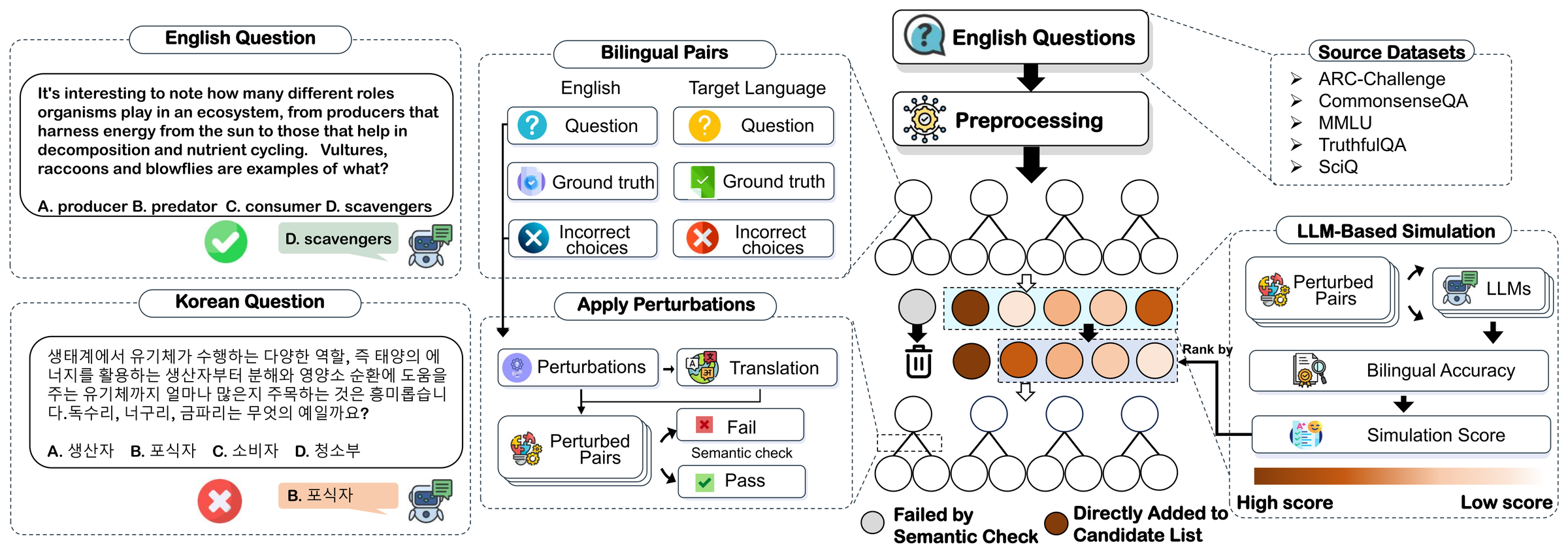
Overview: Active Cross-Lingual Failure Discovery
Cross-Lingual Pitfalls introduces search-based multilingual LLM evaluation. It actively discovers cross-lingual weaknesses: cases where a model answers a question correctly in English but incorrectly in a semantically checked target-language version.
Rather than only measuring average accuracy on a fixed multilingual test set, the method combines beam search and LLM-based simulation to find questions that expose an English–target-language performance gap. The released resource contains 6,713 bilingual pairs across 16 target languages, originating from MMLU, ARC, CommonsenseQA, TruthfulQA, and SciQ. This is a failure-focused collection, so its observed accuracy gaps describe the selected questions and experimental models—not average performance for all users or questions in those languages.
In the authors' words, the work makes three contributions:
- "We present an efficient, precise methodology for identifying LLM cross-lingual weaknesses."
- "we construct a novel, 16-language dataset with over 6,000 bilingual pairs to challenge cross-lingual capabilities."
- "Extensive experiments ... quantitatively analyze the relationship between cross-lingual weaknesses and linguistic similarities and fine-tuning experiments demonstrate the potential for targeted cross-lingual improvement."
From Fixed Benchmarks to Active Failure Discovery
Fixed multilingual benchmarks estimate performance on their chosen questions; cross-lingual consistency tests whether a model handles corresponding questions similarly across languages. Cross-Lingual Pitfalls adds a complementary question: can we automatically find where that consistency breaks? Searching for English-correct, target-language-wrong pairs can reveal conditional failure regions that an aggregate score obscures.
The generation method can be run again to probe other model settings. The published 6,713-pair dataset is a fixed release, not a continuously changing benchmark. The work probes multilingual question answering and cross-lingual failure discovery; it is not a benchmark of cultural knowledge, code-switching, translation quality, safety, or agent tool use.
Abstract
Large Language Models (LLMs) have achieved remarkable success in Natural Language Processing (NLP), yet their cross-lingual consistency remains a significant challenge. This paper introduces a novel methodology for efficiently identifying inherent cross-lingual weaknesses in LLMs. Our approach leverages beam search and LLM-based simulation to generate bilingual question pairs that expose performance discrepancies between English and target languages. We construct a new dataset of over 6,000 bilingual pairs across 16 languages using this methodology, demonstrating its effectiveness in revealing weaknesses even in state-of-the-art models. The extensive experiments demonstrate that our method precisely and cost-effectively pinpoints cross-lingual weaknesses, consistently revealing over 50% accuracy drops in target languages across a wide range of models. Moreover, further experiments investigate the relationship between linguistic similarity and cross-lingual weaknesses, revealing that linguistically related languages share similar performance patterns and benefit from targeted post-training. Code is available at https://github.com/xzx34/Cross-Lingual-Pitfalls.
Key Findings on the Searched Failure Cases
1.Large gaps on failure-focused questions
On the bilingual pairs selected by the probing procedure, English accuracy is nearly 100%, while most evaluated models show target-language accuracy drops of over 50% in the paper's setting. These numbers show that the search can find substantial weaknesses; they are not estimates of a model's average accuracy across the language as a whole.
2.Strong models still have discoverable gaps
The ten-model evaluation includes GPT-4o and Claude-3.5-Sonnet. On the selected Chinese pairs in the reported experiments, the average drop across models is nearly 60%, and GPT-4o's drop is nearly 30%. These are results for this failure-focused set, not a general Chinese-language performance estimate.
3.Some failure patterns and improvements transfer
The paper analyzes how linguistic similarity relates to shared cross-lingual weaknesses. Its targeted post-training experiments show transfer among some tested languages, suggesting that discovered failures can inform more than one language. The experiments do not establish universal transfer across all language groups.
4.Low-resource languages warrant closer diagnosis
Among the evaluated languages, the selected pairs in Amharic, Yoruba, Swahili, and Zulu reveal particularly large English–target-language gaps. This motivates targeted evaluation beyond English, while the selected-set design does not measure the overall failure rate for speakers of those languages.
5.A rerunnable diagnostic, alongside the fixed dataset
The reported cost of identifying a bilingual pair that exposes a weakness is less than $0.05 for most languages in the paper's setting. The search procedure can be rerun for new model settings; the published dataset remains a fixed, citable snapshot.
How We Search for Cross-Lingual Failures
Cross-Lingual Pitfalls uses beam-search perturbations and LLM-based simulation to find bilingual question pairs that expose English–target-language discrepancies. It is an active probing method that complements fixed multilingual benchmarks, rather than another estimate of average multilingual accuracy.
Starting from English questions drawn from MMLU, ARC, CommonsenseQA, TruthfulQA, and SciQ, the search proposes question variants, checks corresponding target-language versions, and scores candidates for a large English–target-language performance gap using LLM-based simulation. The paper evaluates the resulting pairs on ten models. A rerun can produce new probes, but the released 6,713 pairs do not change automatically.
Models used to generate pairs (5): Llama-3.1-8B, Gemma-2-9B, Gemma-2-27B, GPT-4o-mini, Qwen2.5-72B.
Models evaluated (10): Llama-3.1-8B, Gemma-2-9B, Gemma-2-27B, GPT-4o-mini, Llama-3.1-70B, Qwen2.5-72B, o1-mini, Yi-Lightning, GPT-4o, Claude-3.5-Sonnet.
Dataset: 6,713 Cross-Lingual Failure Probes
The fixed dataset contains 6,713 bilingual question pairs spanning 16 target languages, built from five English QA benchmarks (MMLU, ARC, CommonsenseQA, TruthfulQA, and SciQ). It is available on the Hugging Face Hub and in the GitHub repository. Its pairs were selected to expose failures, so comparisons on this resource should not be presented as representative language-wide accuracy.
6,713 bilingual English–target pairs · 16 languages · built from five English QA benchmarks · designed to expose cases where an LLM is correct in English but wrong in the target language · released on Hugging Face and GitHub · useful for evaluating cross-lingual consistency, multilingual robustness, and non-English failure modes.
Chinese342
Japanese314
Korean456
French312
Spanish242
Italian295
Ukrainian323
German322
Bengali431
Hindi327
Arabic424
Hebrew319
Amharic665
Yoruba813
Swahili417
Zulu711
Total across 16 languages: 6,713 bilingual (English ↔ target) pairs.
In the paper's evaluation on selected pairs, Amharic, Yoruba, Swahili, and Zulu show particularly large gaps. Counts above report dataset sizes only; per-language accuracy results and experimental details are in the paper.
From Failure Discovery to Multilingual Post-Training
Finding a failure can also identify a training opportunity. The paper tests targeted post-training with Chinese and French pairs, using supervised fine-tuning and simulated preference optimization on four models. It examines whether improvements carry over to other tested languages and finds transfer in some related or similar language settings. These experiments support a targeted route from diagnosis to improvement, without establishing a universal post-training recipe.
Frequently Asked Questions
What is Cross-Lingual Pitfalls?
Cross-Lingual Pitfalls is an ACL 2025 paper on search-based multilingual LLM evaluation. It uses beam search and LLM-based simulation to discover English-correct, target-language-wrong question pairs, and releases a fixed dataset of 6,713 bilingual pairs across 16 target languages.
What is a cross-lingual weakness?
A cross-lingual weakness is a case where a model answers an English question correctly but fails on a semantically checked version in a target language. The paper searches for these cases to diagnose cross-lingual inconsistency, rather than using them to estimate average performance for all questions in a language.
How does this differ from fixed multilingual benchmarks?
Fixed benchmarks estimate performance on chosen questions. Cross-Lingual Pitfalls instead searches for questions on which English-correct answers fail in a target language. It complements fixed benchmarks and cross-lingual consistency tests by actively locating conditional failure cases that an aggregate score can obscure.
Is the released dataset dynamic?
No. The published 6,713-pair dataset is a fixed release. The automatic generation method can be rerun to search for new weaknesses under other model settings.
What do the reported accuracy drops mean?
The paper reports that most evaluated models lose over 50% target-language accuracy on the selected failure-focused pairs. In its Chinese experiments, GPT-4o also shows a nearly 30% drop. These results demonstrate discoverable weaknesses on the searched set; they are not population-wide estimates of multilingual accuracy.
What languages and data are released?
The fixed dataset has 6,713 English-to-target-language question pairs across Chinese, Japanese, Korean, French, Spanish, Italian, Ukrainian, German, Bengali, Hindi, Arabic, Hebrew, Amharic, Yoruba, Swahili, and Zulu. The source questions come from MMLU, ARC, CommonsenseQA, TruthfulQA, and SciQ. The dataset is available on Hugging Face and GitHub.
Does this benchmark translation quality or cultural knowledge?
No. The study uses bilingual questions to probe multilingual question answering and cross-lingual consistency. It does not evaluate machine translation quality, culturally grounded knowledge, code-switching, safety, or agent tool use.
Can discovered failures inform post-training?
The paper tests targeted post-training with Chinese and French pairs on four models using supervised fine-tuning and simulated preference optimization. It reports transfer in some tested language settings, but does not establish universal transfer or a general training recipe.
When should I cite this paper?
Cite Cross-Lingual Pitfalls for search-based multilingual evaluation, automatic cross-lingual failure discovery, English-correct and target-language-wrong cases, cross-lingual consistency analysis, or targeted multilingual post-training. The When to Cite This Paper section gives a suggested citation sentence.
When to Cite This Paper
Cross-Lingual Pitfalls is a useful reference when your work touches any of the following:
- search-based or active multilingual LLM evaluation;
- automatic discovery of cross-lingual weaknesses and consistency failures;
- English-correct, target-language-wrong cases that aggregate benchmark scores can obscure;
- failure-focused bilingual question sets across 16 target languages;
- targeted multilingual post-training informed by discovered failures.
A typical citation: Xu et al. (2025) introduce a search-based probe that automatically discovers English-correct, target-language-wrong questions, complementing fixed multilingual benchmarks with targeted cross-lingual failure discovery.
Resources
- arXiv:2505.18673 — abstract page (submitted 24 May 2025). HTML version.
- ACL Anthology — ACL 2025, Vienna, Austria, pages 8254–8284, DOI 10.18653/v1/2025.acl-long.404.
- Dataset on Hugging Face — the 16-language, 6,713-pair benchmark, loadable with the
datasetslibrary. - Code & dataset on GitHub — MIT license; the 16-language dataset ships inside the repository.
BibTeX
Official ACL Anthology citation
@inproceedings{xu-etal-2025-cross,
    title = "Cross-Lingual Pitfalls: Automatic Probing Cross-Lingual Weakness of Multilingual Large Language Models",
    author = "Xu, Zixiang  and Wang, Yanbo  and Huang, Yue  and Chen, Xiuying  and Zhao, Jieyu  and Jiang, Meng  and Zhang, Xiangliang",
    editor = "Che, Wanxiang  and Nabende, Joyce  and Shutova, Ekaterina  and Pilehvar, Mohammad Taher",
    booktitle = "Proceedings of the 63rd Annual Meeting of the Association for Computational Linguistics (Volume 1: Long Papers)",
    month = jul, year = "2025", address = "Vienna, Austria",
    publisher = "Association for Computational Linguistics",
    url = "https://aclanthology.org/2025.acl-long.404/",
    doi = "10.18653/v1/2025.acl-long.404",
    pages = "8254--8284", ISBN = "979-8-89176-251-0"
}
Prefer the preprint? An arXiv citation for 2505.18673 is also available from the arXiv page.